Lamb Escape: Jam Animal Farm
- 4.9
- Rating
- 1.00M
- Installs
- Free
- Price

 Analysis by App-foxy
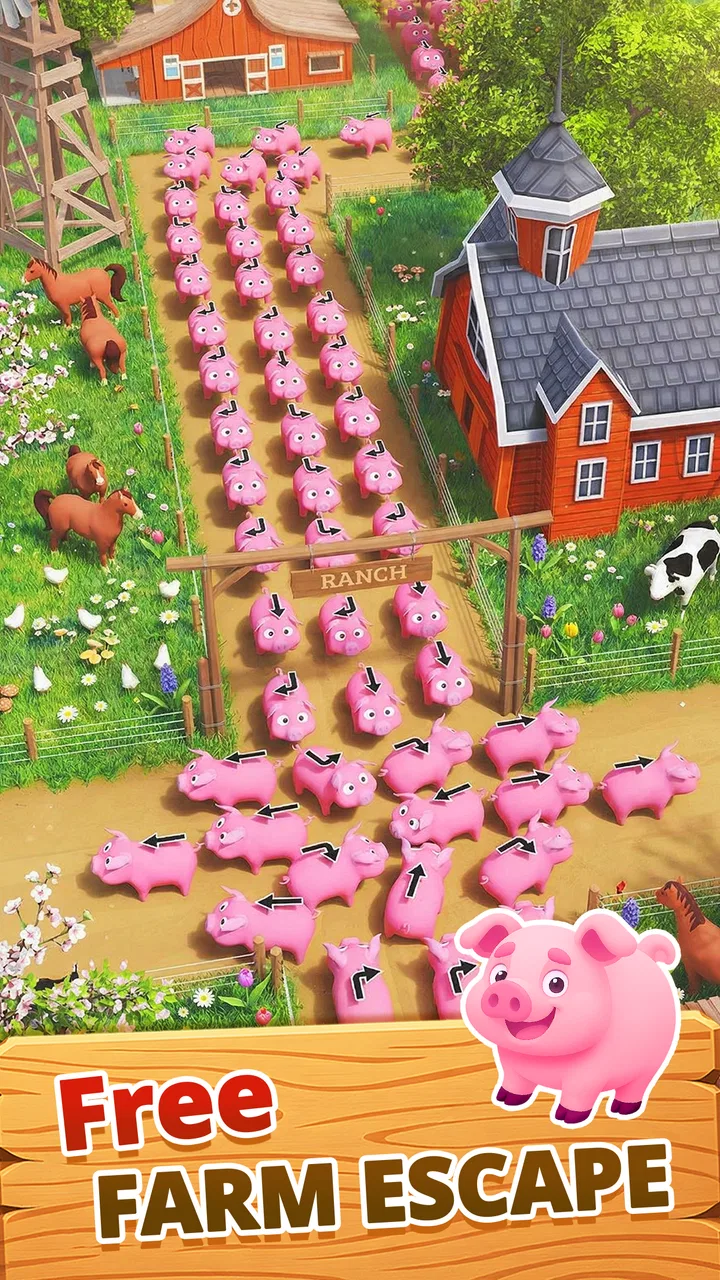
I spent time with Lamb Escape: Jam Animal Farm as a light racing game built around a simple farmyard problem: animals need a clear route through a crowded situation, and your job is to help them reach safety and win. That premise is easy to understand within moments, which is exactly what makes it approachable on a phone. I did not need a long tutorial or a complicated control scheme before getting involved.
What surprised me is how much of the experience depends on reading the scene before acting. The game looks cheerful and uncomplicated, but the best results come from resisting the urge to move immediately. I found myself checking which animal should go first, where a route might become blocked, and whether a quick move would create a worse jam a few seconds later. It is a small-scale challenge, but it rewards attention rather than frantic tapping.
EasyFun Puzzle Game Studio presents it as a free game for everyone, and that description fits the tone. It is suitable for short sessions, casual players, and younger users who enjoy colorful animal themes. At the same time, the racing label should not make you expect a traditional driving game with cars, tracks, or high-speed steering. This is closer to a puzzle-like animal escape experience with movement and victory goals than to a conventional racing title.
You May Also Like

 Blood Strike: 2.5 Anniversary
Blood Strike’s Loadouts Turn Every Drop Into a Tactical Gamble
A close look at Blood Strike’s custom loadouts: how fast access to signature weapons reshapes its battle royale rhythm, rewards preparation, and narrows the gap between fights.

 Pandora - Music & Podcasts
Pandora’s Music Is Easy to Start, but Harder to Recover
Pandora’s strength is its low-effort path from a seed to a station. Its weak spot is how much confidence it asks you to place in connection, setup, and quiet recovery.

 8 Ball Pool
 Is Built on Rivalries, Rematches, and Routine
A close look at the rivalries, rematches, shared routines, and unanswered safety questions that turn a quick pool match into a persistent mobile community.

 Samsung Music
’s Quiet Strength Is Playing What You Already Own
Its reach comes less from spectacle than from dependable access to a personal library. That simplicity is both the app’s strongest retention engine and its ceiling.

 AccuWeather: Weather Radar
AccuWeather Review: A Quick, Clear Forecast for Everyday Decisions
For everyday plans, the best forecast is the one you can understand quickly. AccuWeather makes rain timing, radar, and local conditions easy to act on, with a few trade-offs.

 Hill Climb Racing
Why Hill Climb Racing Still Turns Crashes Into One More Run
A tiny car, a bumpy hill and one more upgrade: Hill Climb Racing keeps resurfacing because its simple chaos makes every near-miss feel personal.
More From Our News Desk
View All News


How the early goals teach the game
The opening goals work because they are immediately readable. I always knew what the broad objective was: untangle the farmyard situation and guide the animals toward a successful escape. That clarity matters on a mobile screen, where a player may open the game while waiting for a bus or taking a short break. There is no need to memorize a large collection of rules before the first meaningful decision.
Early play also establishes a useful habit: observe first, then commit. When several animals appear to compete for space, moving the obvious one is not automatically the smartest choice. A route that looks open can become inconvenient if another animal needs the same area. I recommend taking a moment to identify the most constrained animal before making the first move. That small pause often prevents the kind of mistake that comes from treating every obstacle as equally important.
This design gives the first sessions a gentle sense of purpose. The goals are not buried under equipment, character statistics, or a large upgrade tree. Instead, progress comes from understanding the arrangement in front of you. For players who like quick visual puzzles, that is a strength. For someone looking for a deep racing career with vehicle tuning and long-term competition, the simplicity may feel too limited from the beginning.
The farm setting helps the game avoid feeling completely abstract. Animals give the action a friendly identity, and the idea of helping them escape makes each successful solution feel more satisfying than merely clearing colored shapes. I found that the theme is especially effective when playing in short bursts because it communicates the purpose of the level without requiring much reading.
Why the first victories feel useful
The early victories are valuable because they teach decision-making rather than just rewarding speed. I learned to look for blocked exits, identify moves that would open more space, and avoid using a convenient route if it trapped another animal behind it. These are practical habits that remain useful as the situations become less forgiving.
A good everyday example is playing during a short coffee break. I could start a session, solve a few situations, and put the phone away without needing to remember a complicated storyline. The game suits that rhythm better than a large racing adventure that expects a longer uninterrupted commitment. Its strongest use case is not a full evening of play; it is the small gap in the day when I want a focused challenge that begins quickly.
There is also a useful distinction between a goal being clear and a solution being obvious. Lamb Escape keeps the destination understandable while leaving the route for the player to work out. That balance is the reason the early stages do not feel like a passive tutorial. Even when the answer is simple, I still have to participate in finding it.
Progress signals and the feeling of moving forward
The game’s progress is communicated mainly through successful escapes and the growing complexity of the situations. That is a modest progression model, but it matches the compact design. I did not need a collection of unrelated rewards to understand whether I was improving. The clearest signal was my own changing approach: at first I reacted to the nearest opening, while later I planned around the entire arrangement.
This is an important strength for a casual game. Progress does not depend entirely on accumulating resources or waiting for a timer. A player can feel advancement simply by solving a situation that would previously have caused confusion. In my experience, that kind of progress is more personal and more immediate than a decorative reward that has little effect on play.
Still, the limited nature of the progression can affect long-term motivation. Players who enjoy unlocking new vehicles, upgrading engines, collecting racers, or building a large garage may find fewer reasons to keep returning once the central challenge becomes familiar. The game is strongest when the act of solving remains enjoyable on its own, rather than when the player expects a large external reward structure.
The current version is 1.2.1, and the game has already attracted over a million installs. Its average rating is 4.9 from roughly seventy-two thousand ratings, with about two thousand four hundred written reviews. Those figures suggest that the straightforward format is connecting with many players, but they should not replace personal judgment. A high rating can tell you that the core idea is popular; it cannot tell you whether you prefer this kind of puzzle movement to a conventional racing game.
I also appreciate that the progress signals are easy to understand without turning the screen into a dashboard. When a game is designed for quick play, too many meters and currencies can distract from the actual problem. Here, the important question remains whether I can create a successful path for the animals. That focus gives the game a cleaner identity.
What to watch for when planning a move
One of my most useful habits was to separate “available now” from “safe later.” An animal may have an immediate route, but using it can remove the space needed for another animal. I started checking the consequences of the first move rather than celebrating an opening too early. This is a small insight, but it changes the game from simple tapping into short-term planning.
Another practical tip is to pay attention to the animal that has the fewest alternatives. If one creature can move through several areas while another seems dependent on a single opening, I treat the restricted route as the priority. This approach is more reliable than following the order in which the animals catch my eye. It also makes failed attempts informative because I can usually identify which early decision caused the later blockage.
For younger players, this makes the game a gentle exercise in sequencing and consequence. For adults, it works as a compact attention reset. I would not describe it as a major strategy game, but it does ask for enough planning to keep the player mentally present.
Difficulty, challenge, and the pace of each session
The difficulty curve is most effective when the game asks me to reconsider familiar habits. A first solution may be based on opening the most visible route, while a later situation encourages me to think about order, space, and the effect of every move. That gradual shift sustains interest better than simply making everything faster or more crowded without explanation.
What I like about this kind of challenge is that failure can teach something specific. If I create a jam, I can look back at the move that caused it and adjust my plan. The game does not need complicated rules to produce that learning loop. The challenge comes from arranging actions correctly, and the satisfaction comes from seeing the whole situation resolve after a better sequence.
There is a trade-off, though. Players who prefer constant speed may find the deliberate pacing slower than expected because the important skill is planning, not reflexes. The racing category may attract people expecting rapid competition, but this experience is better suited to someone who enjoys solving a route under pressure. If you want drifting, acceleration, lap times, or direct head-to-head action, a standard racing game would be a better choice.
The pacing works well for mobile use because it allows me to alternate between concentration and release. I study the arrangement, make a move, observe the result, and then decide whether to continue or rethink the plan. That rhythm makes the game comfortable during brief sessions, although players who want a dramatic sense of speed may find it restrained.
One advanced approach is to avoid solving only the next obstacle. I try to imagine the final few movements before committing to the first one. I do not always see the complete answer, but even a rough end-state check can reveal that a tempting opening leaves an animal with nowhere useful to go. This is where the game’s challenge becomes more interesting: the player is not merely finding movement, but preserving future options.
When the difficulty becomes less comfortable
A puzzle can feel challenging in a good way when the rules are clear and the mistake is understandable. It becomes frustrating when a player cannot tell why a route failed. With Lamb Escape, I found it important to slow down and treat each attempt as a test of order. If I rushed, I was more likely to blame the layout instead of noticing that I had closed the only practical path for another animal.
That means the game rewards patient players more than impulsive ones. Someone who likes restarting quickly and experimenting may enjoy this, while someone who wants every move to produce immediate progress may lose interest. The experience is not designed around a constant reward rush; its best moments arrive when a careful plan finally works.
I would also avoid judging the game after only a few effortless successes. The early goals establish the vocabulary, but the real question is whether you enjoy applying that vocabulary to increasingly awkward arrangements. If you do, the pacing has room to hold attention. If you only enjoy the novelty of the farmyard theme, the lack of a deeper competitive layer may become noticeable sooner.
Retention pressure, free play, and everyday friction
Because the game is free, it is easy to try without making a purchase decision first. It is rated Everyone, requires Android 8.0 or later, and fits the kind of casual installation I would recommend to someone who wants a low-commitment game. The listed in-app purchases range from $1.99 to $9.99 per item, so players should remember that free access and optional spending are separate parts of the experience.
I see the main retention pressure coming from the desire to solve the next situation rather than from a heavy collection system. That is healthy when the challenge remains varied enough to justify another attempt. The risk is that once the patterns become familiar, a player who needs constant unlocks or dramatic new mechanics may feel that the reason to return is too narrow.
For me, the most natural routine is to use it as a short mental break. I might play while waiting for an appointment, stop after a handful of successful escapes, and return later without feeling that I have abandoned a large campaign. That low commitment is a genuine advantage. It also means the game is less suitable for someone searching for a primary game with a strong long-term identity.
One trade-off worth considering is the difference between challenge-based retention and reward-based retention. Lamb Escape’s appeal depends on whether solving the animal traffic remains satisfying. If you need daily bonuses, extensive customization, or a large roster to keep you engaged, this may not provide enough variety. If you prefer a clean objective and the satisfaction of improving your own planning, the simpler structure is more appealing.
I would let a child play it as an approachable puzzle game, but I would still explain that optional purchases exist before handing over a device connected to a payment method. The Everyone rating makes the theme broadly accessible, yet age suitability and spending habits are separate questions. That is a practical consideration for families, not a criticism of the animal-focused presentation.
Who should choose it and who should skip it
I recommend it to players who want a friendly, easy-to-learn challenge with a farm setting and short-session pacing. It is a good fit for someone who enjoys arranging moves, spotting bottlenecks, and improving after a failed attempt. It can also work for families looking for a simple game that does not depend on realistic competition or complicated controls.
I would skip it if your main reason for downloading a racing game is speed. There are better choices for realistic tracks, car handling, upgrades, and competitive timing. I would also look elsewhere if you need a large story, a deep progression tree, or a strong social component. The game’s identity is narrower: guide the animals, manage the jam, and solve the route.
Another group that may want to pass is anyone who dislikes repeating a type of puzzle. The central idea remains consistent, and that consistency is part of its accessibility. It is not trying to become a different genre every few stages. Whether that feels focused or repetitive depends on how much variety you expect from a free mobile game.
My progression verdict after playing
The progression works because the early goals are clear, the signals of improvement are understandable, and the challenge grows through better planning rather than unnecessary complexity. I could see exactly what I was trying to accomplish, and I could usually identify why a failed attempt had gone wrong. That makes the game easy to recommend as a casual reasoning experience.
Its limitations are just as clear. The farmyard theme and animal escapes give the game personality, but the core activity remains focused. Players who need a broad set of unlocks or the excitement of traditional racing may find the long-term structure too light. The free format is inviting, while the optional purchases mean families should keep an eye on spending settings.
Overall, I think this is a better choice for a quick planning game than for a full racing replacement. The most rewarding sessions came when I stopped treating each opening as an invitation to tap and started protecting future routes. That small shift gives the simple premise more depth than the first glance suggests.
My final recommendation is straightforward: download it if you want cheerful farmyard puzzles that fit into spare minutes and reward patience. Choose another game if you are looking for speed, vehicle progression, or a large competitive career. For the right player, the restrained design is not a weakness; it is what makes a short session easy to start, understand, and enjoy.
FAQs for Lamb Escape: Jam Animal Farm
01What is Lamb Escape: Jam Animal Farm about?
Lamb Escape: Jam Animal Farm is a vibrant and engaging puzzle game where players help a lamb navigate through various farm-themed levels to escape and reunite with its flock. The game combines strategic thinking with fun, offering a range of challenges that increase in complexity as you progress.
02Is Lamb Escape: Jam Animal Farm free to play?
Yes, Lamb Escape: Jam Animal Farm is free to download and play on both Android and iOS platforms. However, it may offer in-app purchases for players who wish to enhance their gaming experience with additional features or items.
03What age group is Lamb Escape: Jam Animal Farm suitable for?
Lamb Escape: Jam Animal Farm is suitable for players of all ages, making it perfect for both kids and adults who enjoy puzzle-solving games. Its colorful graphics and simple controls make it accessible, while its increasing difficulty levels keep it challenging for more experienced players.
04Are there any ads in Lamb Escape: Jam Animal Farm?
While Lamb Escape: Jam Animal Farm is free to play, it does contain ads. These ads help support the developers and can typically be removed with an in-app purchase. For an uninterrupted experience, players can opt for the ad-free version available within the app.
05Can Lamb Escape: Jam Animal Farm be played offline?
Lamb Escape: Jam Animal Farm can be played offline, allowing players to enjoy the game without an internet connection. However, certain features such as updates, in-app purchases, and leaderboards may require an internet connection to function properly.
Pros
- Engaging and colorful graphics.
- Simple controls for easy gameplay.
- Variety of levels to explore.
- Fun challenges and obstacles.
- Suitable for all age groups.
Cons
- Limited customization options.
- Repetitive background music.
- Ads can be intrusive.
- In-app purchases can be costly.
- Requires constant internet connection.

Lamb Escape: Jam Animal Farm
Gallery